
Spatial Prepositions in Hieroglyphic Ancient Egyptian and nine other languages
Languages differ in respect to the linguistic devices they use to encode simple static spatial relations. Many languages use prepositions for that purpose. They divide the cognitive space of possible spatial relations into different subspaces. Topoi researcher Daniel Werning investigated the corresponding semantic maps of simple spatial relations in Hieroglyphic Ancient Egyptian, Akkadian, Arabic, English, French, German, Hebrew, Italian, Russian, and Spanish.
The meaning and use of prepositions in foreign languages is notoriously difficult to understand for a nonnative speaker. This is because the use of seemingly equivalent prepositions, like English on and German auf, do not actually match perfectly. German differentiates, for example, between Der Stift liegt AUF dem Tisch and Das Bild hängt AN der Wand. English, on the other hand, uses the same preposition on in both cases: The pen is ON the table and The picture is ON the wall. We see that languages divide the realm of possible spatial relations into different partially overlapping subspaces.
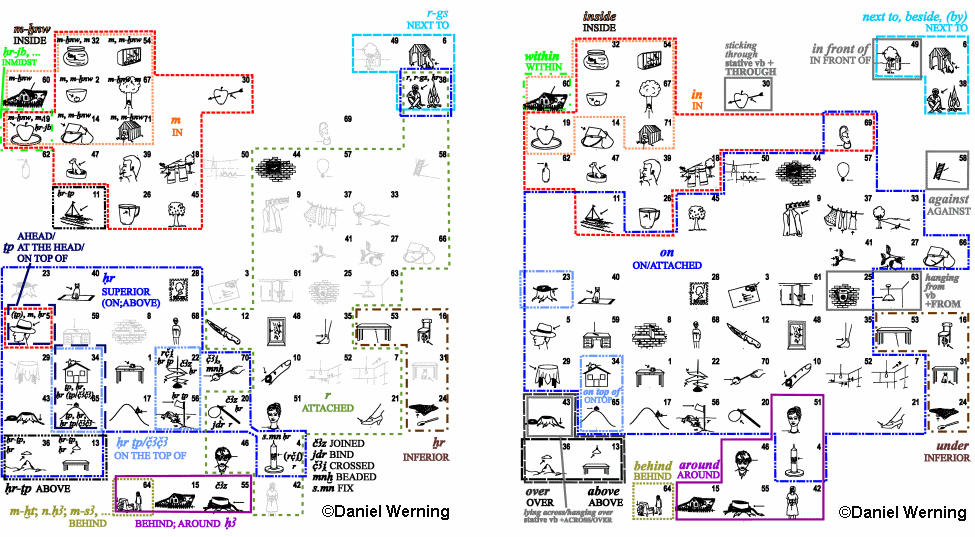
Fig. 1: The semantic space of simple static prepositions in Hieroglyphic Ancient Egyptian (a) and English (b) (Daniel Werning)
It is possible to visualize and compare the subspaces that prepositions of different languages cover on a semantic map of simple spatial relations by using a fixed set of pictures that show various simple spatial configurations, the Topological Relations Picture Series. Based in the research group The Conception of Spaces in Language (C-I-1), Daniel Werning investigated the corresponding semantic maps of simple spatial relations in Hieroglyphic Ancient Egyptian, Arabic, English, French, German, Hebrew, Italian, Russian, and Spanish, as well as data from a parallel study on Akkadian by Topoi Fellow Dr. Ulrike Steinert. On the one hand, this research enhances the translation of prepositions of ancient languages to modern languages. More generally, however, research like this enables a better understanding of the subtle differences in use and meaning of spatial prepositions in ancient and modern languages alike. And it sheds some light on what concepts are salient for native-speakers of different languages. Interestingly, among these concepts are not only topological concepts like vertical/horizontal ALIGNMENT, CONTACT, or CONTAINMENT, but, equally important, also functional concepts like SUPPORT (German auf, English on#1) or CONTROL (in, inside) or qualitative concepts like ATTACHMENT (German an, Egyptian r, English on#2).
Related Links
Event: Project workshop “Visualizing Relations of Meanings on Semantic Maps”
Read more articles in TOPOI FEATURE